
So let’s start with a few easy botanical terms, and what they mean.
Alternate or opposite leaves?
If you’re looking at a plant and wondering what it is, this is one of the first identifying features to look for.
Opposite simply means that the leaves are in pairs. Here is a specimen of a local climber with opposite leaves.

Stiff Jasmine, Jasminum simplicifolium - for more details on this plant see: https://toowoombaplants2008.blogspot.com/search?q=pearls
Alternate means the leaves are joined onto the twig (botanical term: branchlet) one at a time, not in pairs. The plant below has alternate leaves along its slightly zig-zagged branchlets.

Scrub Wilga, Geijera salicifolia - for more details on this plant see:
https://toowoombaplants2008.blogspot.com/search?q=bone-chilling.
Simple or Compound Leaves?
This is a little trickier. A simple leaf is never divided into leaflets. Simple leaves come in a lot of different shapes, but there is always is just a single leaf-blade, joined directly to the branchlet. The Jasmine and the Wilga above have simple leaves.
So does the plant below - and you will notice that they are opposite.

Red Olive-plum Elaeodendron australe var. integrifolium, - for more details on this plant see:
https://toowoombaplants2008.blogspot.com/search?q=olive-plum
Another local with simple, opposite leaves is this one.

Small Fruited Mock Olive, Notelaea microcarpa - for more details on this plant see:
https://toowoombaplants2008.blogspot.com/search?q=Rosenthal
This one has simple, alternate leaves:

Scrub Boonaree, Alectryon diversifolius - for more details on this plant see:
https://toowoombaplants2008.blogspot.com/search?q=dormitory
And here’s another one which also has simple, alternate leaves:

Instead of being simple, leaves can be compound.
This means that the leaf is divided up into sub-leaves (botanical term: leaflets). This cam be confusing, because leaflets look rather like leaves!
The picture below shows ONLY THREE leaves. They are the kind called compound leaves, rather than simple leaves.

White Beetroot Tree Elattostachys xylocarpa - for more details on this plant see:
https://toowoombaplants2008.blogspot.com/search?q=multiple-trunked
Two of its leaves are divided into five leaflets each, and the other leaf has only two leaflets.
You could mistake those leaflets for simple leaves, couldn’t you?

White Beetroot Tree Elattostachys xylocarpa
The difference can be seen by looking at the join between the leaf-stalk and the branchlet. (The botanical term for this join is “axil”.) Can you see that there is a shoot coming from the axil? Only leaves have those shoots. There is never a shoot at the base of leaflets. The position of the shoot tells you that you are looking at compound leaves.
(And did you notice that this plant has alternate leaves?)
So does this one below - and its compound leaves are very large.

Note the tiny shoot in the leaf axil, by my finger. The shoots in leaf axils are sometimes just very small points, so you need to look carefully for evidence that this is a compound leaf.
Also note the white sap oozing from the places where I have snipped off leaves, so I could show a clear photo of a single leaf. Relatively few trees have white sap, so this is an important identifying feature. (I washed my hands afterwards, an important precaution after handling this kind of plant.)
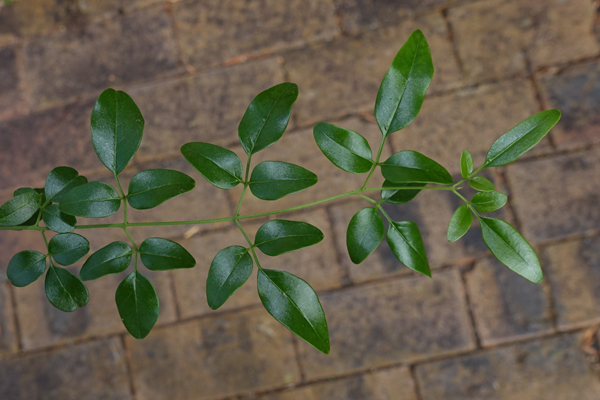
White beetroot tree and Deep Yellowood have the kind of compound leaves called pinnate leaves. Pinnate is a word about feathers. Can you see how the leaves in the photo above are arranged a bit like a feather - with a leaflets lined up on either side of the central rib, like the barbs of a feather? The central rib of the leaf is called the rachis. (Pronounced RAH-KIS) The strong central spine of a feather is a rachis, too.
Trifoliate Leaves
Here is another plant with compound leaves. In this case, its leaves are opposite.
Triple Leaf Jasmine, Jasminum didymum subsp. racemosum - for more details on this plant see:
https://toowoombaplants2008.blogspot.com/search?q=didymum
Despite its deceptive common name, it is the leaflets that are triple, not the leaves. If you look closely (double click on the photo) you can see the beginnings of shoots in the leaf axils.
Plants with compound leaves, having three leaflets arranged in this pattern are called “trifoliate” (or some people prefer “trifoliolate”, which is such a tongue twister that the word is dropping out of use, despite its being more correct). So the jasmine above has opposite, trifoliate leaves.
Here is another example of compound leaves which are trifoliate.

Can you see that there is a tiny shoot at the base of those trifoliate leaves? And that the leaves are opposite?
Now for a plant family - one with spikes.
A word that helps you identify quite a few of the trees in our local scrubs and dry rainforests is Sapindaceae, (Usually pronounced SAP-IN-DAY-SEE)
It is the name of a plant family, and we have an unusually large number of its members here in our local area. They all have alternate leaves. A few, (like the Scrub Boonaree) have simple leaves, but most of our local Sapindaceae have pinnately compound leaves.
Members of this family can be picked out from other plants with pinnate leaves by a small spike at the tip of the rachis, just where the top leaflet-stem joins on.

Scrub Boonaree, Cupaniopsis parvifolia. FAMILY: Sapindaceae

We’d better have a closer look

White Beetroot Tree, Elattostachys xylocarpa. FAMILY: Sapindaceae
And here's another member of the Sapindaceae family.

Pitted Coogera, Arytera foveolata. FAMILY: Sapindaceae
The spikes at the tip of the rachis, of its pinnately compound, alternate leaves, are rather blunt.

Pitted Coogera, Arytera foveolata. FAMILY: Sapindaceae
Looking at the back of the Beetroot Tree's leaflets, you can notice another interesting feature.

White Beetroot Tree, Elattostachys xylocarpa.
There are little hairy pits, at each junction of a side vein with the main central vein,. These pits are called domatia. The word means “little homes”, and that’s exactly what domatia are.

Domatia are good investments for the trees that have them. They have evolved these structures so they can be landlords. Small mites move in, and “pay their rent” by preying on small insects which would otherwise eat the leaves.
Some species of plants have them, and some don't. Where domatia are present, they give another clue to the identity of the plant.
These leaves also have domatia.

You could easily overlook them, couldn't you? If you double-click on the photo they will be easier to see, and now that you know the word, domatium, perhaps you will look with more interest at the backs of leaves and leaflets.
And I hope that you will be more aware of whether leaves are alternate or opposite, and whether they are simple or compound. If they are compound, you can look to see whether they are trifoliate or pinnate. If they are pinnate you can check whether they are members of the Sapindaceae family.
What else can you learn about leaves?


