Showing posts sorted by relevance for query didymum. Sort by date Show all posts

Thursday, January 2, 2020

TRIPLE-LEAF JASMINE
Jasminum didymum subsp. racemosum
FAMILY: OLEACEAE


This common local plant is one of our four local species of jasmine. A mature plant produces large numbers of tiny, fragrant white flowers in summer, and is a favourite feeding spot for insects including various species of native bee.  The dense foliage offers good nesting sites for small birds, which are also attracted by the insect smorgasbord, and the fruits, which ripen to black.


When I planted it twenty years ago, my idea was to cover this trellis with the jasmine to make a
screen.


As you can see, the jasmine had other ideas!  Despite failing to gain the neat screen I had planned for, I have since grown to love the plant’s non-conformist shape. Almost completely concealed in the above photo is a native beehive, appreciating the shade in the heat of summer.


In autumn, I give the jasmine a trim to let in the sun. The hive is situated on the eastern side of the trellis with a northern aspect, so it is snugly situated to pick up the winter sunlight until mid-day, while sheltering from our cold August winds.


 The triple-leaf-jasmine was slow to grow in its first year or two, and I planted some desert jasmine (Jasminum didymum subsp. lineare) on the same trellis. It is still there, but a little difficult to find among the much greater bulk of its broader-leafed cousin’s canopy.


This jasmine (and probably most of the other jasmine species) is happy to be refreshed by hard pruning. I recently decided it was time to take my plant back to basics, because I was concerned that its weight might be putting too much strain on the twenty-year-old trellis. I trimmed it down to its woody skeleton. What I learned from picking up the clippings was that despite their apparent bulk, the weight was negligible and I need not have worried. What an excellent plant this would be for a rooftop garden or large balcony - the size of a substantial shrub, but without the weight.
I removed every scrap of leaf, and for a few weeks I worried that I had overdone it. What it I had killed my beloved jasmine?!!  To my relief it has bounced right back.


As the photo shows, it is still stubbornly determined to make its bulk at the top of the trellis. Meanwhile I have cut off its flowering stems for this summer, so will have to wait another year for flowering. A gentle trim no later than March should help the new growth to thicken up still more, and give the plant time to put on a good insect-feeding display next summer.

In the wild, This jasmine often grows as a tangled shrub-like thicket, providing shelter for wildlife of many kinds. the photo below, however, shows one which has used a shrub - long since dead - as a trellis. The result is a little jasmine tree, something that could be reproduced in a garden, with the right kind of support.


Tuesday, December 31, 2019

SWEET JASMINE


Jasminum dianthifolium
(Jasminum suavissimum)

FAMILY: OLEACEAE


This little plant, like all the jasmines, can be a twiner with the ability to climb. However it can also spread underground, and is more often seen as a small, low-growing plant in grasslands. Its substantial underground root system means that it can withstand grazing, and (as seen below) attacks by a Council grader. What seem to be a group of plants in the picture probably comes from a single root.


It has what I think is the best perfume of all the local jasmines. You might like to compare it with the other local jasmine species (Jasminum simplicifolium,  Jasminum didymum subsp.  racemosum,
Jasminum didymum subsp. lineare, and the natural hybrid, Jasminum simplifolium x suavissimum), to find your own favourite. The perfume is strongest in the evenings and early mornings, which is typical of moth-pollinated flowers.


Provided they are found by pollinators, the flowers will be followed by small, succulent black fruits, which appeal strongly to small birds.

In a garden, the best situation for this plant might be an a mulched shrubbery, where it can wander at will, popping up wherever it likes. However it can be grown in many situations, including in a pot where it can be left to trail over the edge, or provided with a tiny trellis. Once established, it can be pruned as hard as you like to help it to grow into a bushy plant.

It likes the dappled light among trees, or a situation where it gets sun for only part of the day,  and tolerates all soils except heavy poorly drained clay.  It survives frost by dying down to its roots, regrowing in spring. Its lifespan is not known, but you can expect it to be long-lived.

Sunday, May 31, 2020

Talking about Leaves

Botanical jargon can seem off-putting to a beginner, but it is worth the trouble of learning a bit of it. Knowing some of the botanical words makes aware of what details about leaves to look for, and the more we know about what to look for, the more details we notice.

So let’s start with a few easy botanical terms, and what they mean.

Alternate or opposite leaves?
If you’re looking at a plant and wondering what it is, this is one of the first identifying features to look for.

Opposite simply means that the leaves are in pairs. Here is a specimen of a local climber with opposite leaves.


Stiff Jasmine, Jasminum simplicifolium - for more details on this plant see: https://toowoombaplants2008.blogspot.com/search?q=pearls

Alternate means the leaves are joined onto the twig (botanical term: branchlet) one at a time, not in pairs. The plant below has alternate leaves along its slightly zig-zagged branchlets.


Scrub Wilga, Geijera salicifolia - for more details on this plant see:
https://toowoombaplants2008.blogspot.com/search?q=bone-chilling.


Simple or Compound Leaves?

This is a little trickier. A simple leaf is never divided into leaflets. Simple leaves come in a lot of different shapes, but there is always is just a single leaf-blade, joined directly to the branchlet. The Jasmine and the Wilga above have simple leaves.
So does the plant below - and you will notice that they are opposite.


Red Olive-plum Elaeodendron australe var. integrifolium, - for more details on this plant see:
https://toowoombaplants2008.blogspot.com/search?q=olive-plum


Another local with simple, opposite leaves is this one.


Small Fruited Mock Olive, Notelaea microcarpa - for more details on this plant see:
https://toowoombaplants2008.blogspot.com/search?q=Rosenthal


This one has simple, alternate leaves:


Scrub Boonaree, Alectryon diversifolius - for more details on this plant see:
https://toowoombaplants2008.blogspot.com/search?q=dormitory


And here’s another one which also has simple, alternate leaves:

Breynia, Breynia oblongifolia.

Instead of being simple, leaves can be compound.
This means that the leaf is divided up into sub-leaves (botanical term: leaflets). This cam be confusing, because leaflets look rather like leaves!

The picture below shows ONLY THREE leaves. They are the kind called compound leaves, rather than simple leaves.


White Beetroot Tree Elattostachys xylocarpa - for more details on this plant see: 
https://toowoombaplants2008.blogspot.com/search?q=multiple-trunked

Two of its leaves are divided into five leaflets each, and the other leaf has only two leaflets.
You could mistake those leaflets for simple leaves, couldn’t you?


 White Beetroot Tree Elattostachys xylocarpa

The difference can be seen by looking at the join between the leaf-stalk and the branchlet. (The botanical term for this join is “axil”.) Can you see that there is a shoot coming from the axil? Only leaves have those shoots. There is never a shoot at the base of leaflets. The position of the shoot tells you that you are looking at compound leaves.
  
(And did you notice that this plant has alternate leaves?)

So does this one below - and its compound leaves are very large.

Deep Yellowwood, Rhodosphaera rhodanthema, - for more details on this plant see: https://toowoombaplants2008.blogspot.com/search?q=deep+yellowwood
 
Note the tiny shoot in the leaf axil, by my finger. The shoots in leaf axils are sometimes just very small points, so you need to look carefully for evidence that this is a compound leaf.

Also note the white sap oozing from the places where I have snipped off leaves, so I could show a clear photo of a single leaf. Relatively few trees have white sap, so this is an important identifying feature. (I washed my hands afterwards, an important precaution after handling this kind of plant.)

White beetroot tree and Deep Yellowood have the kind of compound leaves called pinnate leaves. Pinnate is a word about feathers. Can you see how the leaves in the photo above are arranged a bit like a feather - with a leaflets lined up on either side of the central rib, like the barbs of a feather? The central rib of the leaf is called the rachis. (Pronounced RAH-KIS) The strong central spine of a feather is a rachis, too.

Trifoliate Leaves

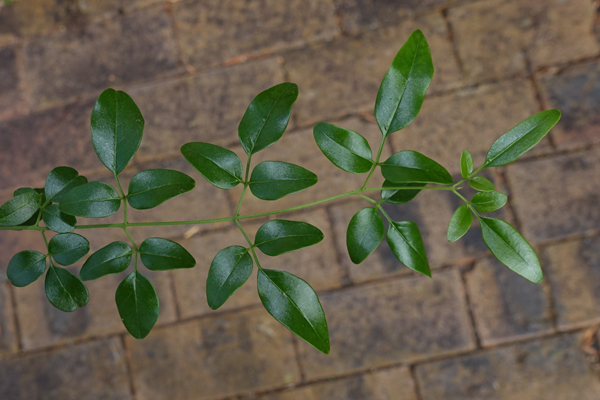
Here is another plant with compound leaves. In this case, its leaves are opposite.


Triple Leaf Jasmine, Jasminum didymum subsp. racemosum - for more details on this plant see:
https://toowoombaplants2008.blogspot.com/search?q=didymum

 
Despite its deceptive common name, it is the leaflets that are triple, not the leaves. If you look closely (double click on the photo) you can see the beginnings of shoots in the leaf axils.

Plants with compound leaves, having three leaflets arranged in this pattern are called “trifoliate” (or some people prefer “trifoliolate”, which is such a tongue twister that the word is dropping out of use, despite its being more correct). So the jasmine above has opposite, trifoliate leaves.

Here is another example of compound leaves which are trifoliate.

Tingletongue, Dinosperma erythrococcum. 
 
Can you see that there is a tiny shoot at the base of those trifoliate leaves? And that the leaves are opposite?

Now for a plant family - one with spikes.
A word that helps you identify quite a few of the trees in our local scrubs and dry rainforests is Sapindaceae, (Usually pronounced SAP-IN-DAY-SEE)
It is the name of a plant family, and we have an unusually large number of its members here in our local area. They all have alternate leaves. A few, (like the Scrub Boonaree) have simple leaves, but most of our local Sapindaceae have pinnately compound leaves.
Members of this family can be picked out from other plants with pinnate leaves by a small spike at the tip of the rachis, just where the top leaflet-stem joins on.


Scrub Boonaree, Cupaniopsis parvifolia. FAMILY: Sapindaceae

 You will also find spikes on the rachis-tips of a plant we looked at, earlier in this blog.


White Beetroot Tree Elattostachys xylocarpa.  FAMILY: Sapindaceae

We’d better have a closer look


 White Beetroot Tree, Elattostachys xylocarpa. FAMILY: Sapindaceae

And here's another member of the Sapindaceae family.


Pitted Coogera, Arytera foveolata. FAMILY: Sapindaceae
 
The spikes at the tip of the rachis, of its pinnately compound, alternate leaves, are rather blunt.
 
 
Pitted Coogera, Arytera foveolata. FAMILY: Sapindaceae


Looking at the back of the Beetroot Tree's leaflets, you can notice another interesting feature.


White Beetroot Tree, Elattostachys xylocarpa.

There are little hairy pits, at each junction of a side vein with the main central vein,. These pits are called domatia. The word means “little homes”, and that’s exactly what domatia are.


White Beetroot Tree, Elattostachys xylocarpa.
 
Domatia are good investments for the trees that have them. They have evolved these structures so they can be landlords. Small mites move in, and “pay their rent” by preying on small insects which would otherwise eat the leaves.

Some species of plants have them, and some don't. Where domatia are present, they give another clue to the identity of the plant.

These leaves also have domatia.
Pitted Coogera, Arytera foveolata

You could easily overlook them, couldn't you? If you double-click on the photo they will be easier to see, and now that you know the word, domatium, perhaps you will look with more interest at the backs of leaves and leaflets.

And I hope that you will be more aware of whether leaves are alternate or opposite, and whether they are simple or compound. If they are compound, you can look to see whether they are trifoliate or pinnate. If they are pinnate you can check  whether they are members of the Sapindaceae family.

What else can you learn about leaves?


Thursday, March 20, 2008

Dry Rainforest at Highfields.


What a special legacy it would be, to leave behind you a patch of local native vegetation for our grandchildren’s grandchildren to appreciate. Charles and Motee Rogers did this, with a bushland reserve on a site next to the Highfields swimming pool and recreation centre.
The vegetation it preserves gives a little taste of what the Highfields environment must have been like, before clearing and gum-trees took over from the original dry rainforest.
Even this precious remnant is relatively impoverished. The vegetation does not have nearly the richness of the scrub in the nearby reserve in Franke’s Road, (which has an amazing 70 species of local native plants, on a much smaller site). However its accessible situation, so close to the shopping centre, makes it a uniquely valuable piece of public land. The Crows Nest Shire Council has been maintaining the reserve, carefully enriching it by planting appropriate local natives in the more open spaces.
This is the perfect time of year for a visit, as so many of the plants are in fruit. The showiest, at the moment, are the red olive-plums, Elaeodendron australis, with their masses of bright orange, olive-shaped fruits, (See article below).
Also visible from the winding path are fruits of:

Hedge Orangebark, Denhamia bilocularis (Maytenus bilocularis). Yellow-orange fruits.


Native Breynia, Breynia oblongifolia. Red fruits ripening to black.


Box-leafed Canthium. Psydrax odorata forma buxifolia. Black fruits


Stiff Jasmine, Jasminum simplicifolium subsp australianse. Black fruits


Peach-leafed Trema, Trema tomentosa, Black fruits.


You'll find Narrow-leafed Orangebark, Denhamia silvestris (Maytenus silvestris) (Yellow-orange fruits); Scrub Tuckeroo, Alectryon diversifolius, (Bright red fruits - see February article); Tape Vine, Stephania japonica., (Red fruits); New England Pimelia, Pimelia novae-anglicae, (Red fruits); and Scrub Jasmine, Jasminum didymum subsp. racemosum, (Black Fruits) as well, and by the footpath outside the entry to the reserve is a Tuckeroo, Cupaniopsis parvifolia, almost finished for the year, but still with a few bright orange capsules hanging on.
All these fruits attract birds, so this is a particularly good time to go birdwatching there, as well.

Tuesday, February 17, 2015

What’s Happening to my Native Bee Hive?

We are very fond of our hive. It was given to us after its discovery in a felled tree, and we made this nice little position for it, facing north-east and sheltered from most of the heat of the summer sun. In winter, the different sun angle plus a bit pruning of the native jasmine (Jasminum didymum subs. racemosum) overhead makes sure it is sun-warmed.


The bees are stingless native honeybees, Tetragonula carbonaria (Trigona carbonaria).
Their hive has thrived, and each day a stream of busy little workers heads back to the hive, with healthy corbicular loads of pollen on their back legs. Although we hadn’t noticed it, some would also have been carrying resin, which they use to make their comb.

Its door usually looks like this:

(The pairs of yellow dots are the rear ends of bees scurrying into the hive laden with pollen, their little black bottoms invisible in the photo.)

Then a few days ago we noticed it looked like this:


Alas, what has happened is that my little native bees have found a cadarghi tree, Corymbia torreliana (Eucalyptus torelliana), whose sticky seeds have been abandoned all around the mouth of the hive.
Cadarghi is a north Queensland gumtree which doesn’t grow naturally south of Ingham. It was widely introduced into southern Queensland as a fast-growing shady garden plant, and has thrived, becoming an environmental weed which damages local ecosystems.
It is interesting botanically, because it has been discovered that native bees disperse its seeds, and this is the first known example of bees as dispersal agents.
The bees don't mean to bring the seeds home. They only want the resin out of the gumnuts, and (no doubt to their annoyance) the seeds stick on to their load of resin. Getting rid of them after cleaning, they are likely to disperse the seeds within 10m of my hive. Here is one of my little bees, carrying out a C. torreliana seed which has accidentally been brought into the hive.


Every 10 seconds or so in the working day, another bee brings out another seed, so hundreds of seeds are being dropped around my garden. Frankly, I could do without this! I already weed out privet, lantana, camphor laurel, jacaranda, Chinese celtis and lantana. Another environmental weed tree is something I do not need.

The bees try to leave their seeds outside before entering their home which is why some seeds are clustered around the door. This bee in the photo below seemed to have almost succeeded. The seed hung by a little sticky thread from the resin on its back leg. It gave up the attempt, and limped into the hive with the seed still attached.


The bees will probably not manage to clean out all the seeds in their hive. What they leave behind may clog passageways and prevent ventilation and free movement of bees.  I have since scraped away the external seeds, which you can see (Photo 3) were beginning to block the doorway, reducing the flow of the air to interior. But I can do nothing about the seeds inside.

Meanwhile there is a risk that the C. torreliana resin which they are now using for interior construction, will start to melt on a hot day. (It has a lower melting point than the other resins they have been using.) We can just hope that the hive’s shaded position and its insulated container will keep it safe from internal collapse.

These native bees are essential pollinators of large numbers of native plant species, and are the only pollinators of some of them. There is a risk that the spread of this harmful tree species, and the resulting damage to the population of our local pollinators, will interfere with the fertilisation of seed of who know which species of native plants. Pollination of Australian plant species is still only very partially studied, so there is much still unknown about how many plants are pollinated. In the fragmented modern remnants of our ecosystems, people are noticing that some healthy trees don't seem to be producing a new generation of seedlings. Perhaps our unwitting damage to populations of pollinators is part of the problem.

........................................................................................


To quote from a Biosecurity Queensland website on Weeds of Australia:
“Cadaghi (Corymbia torelliana) is regarded as an environmental weed in south-eastern Queensland and as a potential environmental weed in New South Wales. It is becoming a serious weed in Queensland, where native bees collect its resin-coated seeds and spread it into eucalypt forests all over south-eastern Queensland.
This species has a very dense canopy of large leaves that is well suited to the rainforests of northern Queensland. When growing in open woodlands, outside its native range, it creates a heavy shade over the native understorey plants and prevents them from growing. It therefore has a significant potential to modify the diversity and structure of the native forests in sub-tropical Australia....
... The sticky resin from the fruiting capsules is collected by native stingless bees (e.g. Trigona carbonaria) and can completely clog the honeycombs and sometimes also seal the bee hive entrance, killing all the bees inside. This tree  often gets covered in a sooty fungus, which can dirty or discolour things that are underneath it (e.g. vehicles, pavers and outdoor furniture). The large horizontal limbs are also prone to snapping off and damaging property.”

(http://keyserver.lucidcentral.org/weeds/data/03030800-0b07-490a-8d04-0605030c0f01/media/Html/Corymbia_torelliana.htm )

A 2013 study on Australian stingless bees by Megan Halcroft, Robert Spooner-\Hart, and Anne Dollin  adds this information:
“Corymbia torelliana seeds are mainly dispersed by gravity; 88% of seeds drop to the ground soon after the fruit opens. However, one or two seeds remain within the gum nut and all are dispersed by Trigona. Resin is produced in the gum nut... When the bee enters the nut to collect resin, the seeds attach to the sticky corbicular load. Seeds are dispersed by bee(s)...and may be spread during the flight back to the nest or transported to the nest itself. This may be up to 1 km away from the tree...
... Trigona are strongly attracted to the resin from C. torelliana and the colonies stop normal foraging activity to collect as much of this resource as possible. As foragers return to the nest some attempt to dislodge seeds on the nest exterior, while others transport seeds directly into the nest cavity. The colony removes some, but not all, of the introduced seeds and these are either disposed of, up to 10m outside the nest or adhere to the sticky surface of the nest entrance... reducing airflow within the nest...
... Resin from C. torelliana may have a lower melting point than many other plant resins. Collection of the resin and its seed occurs during the hottest months of the year in Australia — December to February... and as temperatures rise, the resin begins to soften. Reports of structural collapse due to seed weight and resin softening are not uncommon, particularly if ambient temperatures exceed 39°C. As a result, some beekeepers remove their hives from C. torelliana areas during resin flow to prevent colonies from collecting the resin and seed mixture. While many Australian beekeepers consider C. torelliana to be a major management problem, others consider it to be a useful source of pollen, nectar and resin.”

The site also remarks:
“Not declared or considered noxious by any state government authorities.”

 http://www.beesbusiness.com.au/articles/Halcroft%20et%20al_ch3%20pot%20honey.pdf
 

Saturday, February 18, 2017

Green Pearls

Jasminum simplicifolium
Family: OLEACEAE
If pearls came in green, I think this is what they would look like.


My stiff jasmine Jasminum simplicifolium  is laden with them at the moment.
When they ripen, they will look like this:


 and will be very appealing to fruit-eating birds.

The flowers that produced them looked like this:


Note the variation in the number of "petals". These jasmines can have anywhere between five and eight.

As with many white flowers, they would have been pollinated by moths attracted by the perfume. For those who are curious to find out whether moths are indeed the pollinators, a quick check of the perfume at night, after the day’s heat has worn off, will tell you. If the perfume is stronger (and Jasmines all have a lovely perfume), then you know that the plant has evolved to attract moths. You may even see the culprits while you are investigating.

A likely pollinator, is this big hawk moth.
 

Pollinators don't necessarily breed on the plant that produced the flowers they feed on, but this Psilogramma menephron does breed on native jasmines. (It is known as the “privet hawk moth”, because it also breeds on the introduced privet, as well as a number of other native and introduced  host plants).

Hawk moths have long tongues, and the long tube of the jasmine flower may have evolved to attract them while preventing other less effective pollinators from reaching the nectar at the base of the tube.

You need to be quick to catch a hawk moth feeding/pollinating, because these fast-flying night feeders dart in to a flower, hover (like a hummingbird) for just a split second, then dart off again.

We saw this Psilogramma menephron caterpillar on our Jasminum didymum subsp. racemosum last month.

Isn’t it a lovely thing? It was being attacked by ants at the time, and it was wriggling about catching them and biting them.

It looks almost ready to pupate. When quite ready, it would have dropped off and burrowed into the ground.


Monday, February 4, 2019

Desert Jasmine

Jasminum didymum subsp lineare (Jasminum lineare)
FAMILY: OLEACEAE

Despite its name, this is a plant we see on the black soil of the Darling Downs. As the name suggests, it is very drought hardy indeed.

It can be distinguished by its triple leaves from Sweet Jasmine, Jasminum dianthifolium, a plant whose simple leaves look much the same. Sweet Jasmine is a low-growing plant that spreads by underground stems.


Desert Jasmine is a variable plant. In full sun, it grows as a shrub about 60cm tall.


If it finds itself close to suitable support, however, its stems will take to twining, and it becomes a small shrubby climber. This means that it may not grow quite as you expected.


If a shrub is what you want, a bit of discipline with the secateurs can keep it in order if it shows signs of turning into a climber. Otherwise it can be left to express its own creative nature among garden shrubs, on a trellis, or in revegetation or wildlife corridor planting.

Desert jasmine is a delight in the garden, because the tiny flowers have a strong jasmine fragrance.  Like all native jasmines, they attract native bees and other small insects.


The little soft black fruits are very appealing to birds.

Its favourite sites are those which provide it with partial shade.

It is frost hardy.