Showing posts sorted by relevance for query multiple-trunked. Sort by date Show all posts

Sunday, May 31, 2020

Talking about Leaves

Botanical jargon can seem off-putting to a beginner, but it is worth the trouble of learning a bit of it. Knowing some of the botanical words makes aware of what details about leaves to look for, and the more we know about what to look for, the more details we notice.

So let’s start with a few easy botanical terms, and what they mean.

Alternate or opposite leaves?
If you’re looking at a plant and wondering what it is, this is one of the first identifying features to look for.

Opposite simply means that the leaves are in pairs. Here is a specimen of a local climber with opposite leaves.


Stiff Jasmine, Jasminum simplicifolium - for more details on this plant see: https://toowoombaplants2008.blogspot.com/search?q=pearls

Alternate means the leaves are joined onto the twig (botanical term: branchlet) one at a time, not in pairs. The plant below has alternate leaves along its slightly zig-zagged branchlets.


Scrub Wilga, Geijera salicifolia - for more details on this plant see:
https://toowoombaplants2008.blogspot.com/search?q=bone-chilling.


Simple or Compound Leaves?

This is a little trickier. A simple leaf is never divided into leaflets. Simple leaves come in a lot of different shapes, but there is always is just a single leaf-blade, joined directly to the branchlet. The Jasmine and the Wilga above have simple leaves.
So does the plant below - and you will notice that they are opposite.


Red Olive-plum Elaeodendron australe var. integrifolium, - for more details on this plant see:
https://toowoombaplants2008.blogspot.com/search?q=olive-plum


Another local with simple, opposite leaves is this one.


Small Fruited Mock Olive, Notelaea microcarpa - for more details on this plant see:
https://toowoombaplants2008.blogspot.com/search?q=Rosenthal


This one has simple, alternate leaves:


Scrub Boonaree, Alectryon diversifolius - for more details on this plant see:
https://toowoombaplants2008.blogspot.com/search?q=dormitory


And here’s another one which also has simple, alternate leaves:

Breynia, Breynia oblongifolia.

Instead of being simple, leaves can be compound.
This means that the leaf is divided up into sub-leaves (botanical term: leaflets). This cam be confusing, because leaflets look rather like leaves!

The picture below shows ONLY THREE leaves. They are the kind called compound leaves, rather than simple leaves.


White Beetroot Tree Elattostachys xylocarpa - for more details on this plant see: 
https://toowoombaplants2008.blogspot.com/search?q=multiple-trunked

Two of its leaves are divided into five leaflets each, and the other leaf has only two leaflets.
You could mistake those leaflets for simple leaves, couldn’t you?


 White Beetroot Tree Elattostachys xylocarpa

The difference can be seen by looking at the join between the leaf-stalk and the branchlet. (The botanical term for this join is “axil”.) Can you see that there is a shoot coming from the axil? Only leaves have those shoots. There is never a shoot at the base of leaflets. The position of the shoot tells you that you are looking at compound leaves.
  
(And did you notice that this plant has alternate leaves?)

So does this one below - and its compound leaves are very large.

Deep Yellowwood, Rhodosphaera rhodanthema, - for more details on this plant see: https://toowoombaplants2008.blogspot.com/search?q=deep+yellowwood
 
Note the tiny shoot in the leaf axil, by my finger. The shoots in leaf axils are sometimes just very small points, so you need to look carefully for evidence that this is a compound leaf.

Also note the white sap oozing from the places where I have snipped off leaves, so I could show a clear photo of a single leaf. Relatively few trees have white sap, so this is an important identifying feature. (I washed my hands afterwards, an important precaution after handling this kind of plant.)

White beetroot tree and Deep Yellowood have the kind of compound leaves called pinnate leaves. Pinnate is a word about feathers. Can you see how the leaves in the photo above are arranged a bit like a feather - with a leaflets lined up on either side of the central rib, like the barbs of a feather? The central rib of the leaf is called the rachis. (Pronounced RAH-KIS) The strong central spine of a feather is a rachis, too.

Trifoliate Leaves

Here is another plant with compound leaves. In this case, its leaves are opposite.
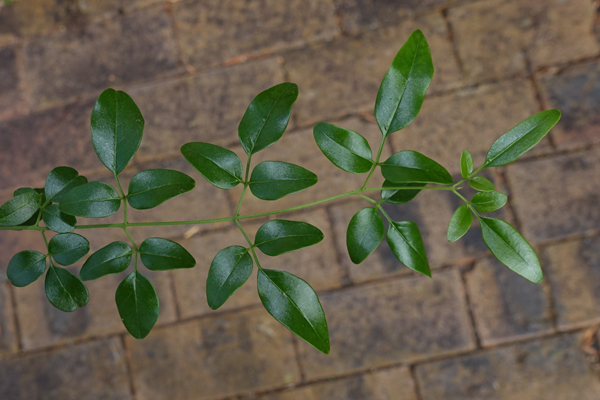


Triple Leaf Jasmine, Jasminum didymum subsp. racemosum - for more details on this plant see:
https://toowoombaplants2008.blogspot.com/search?q=didymum

 
Despite its deceptive common name, it is the leaflets that are triple, not the leaves. If you look closely (double click on the photo) you can see the beginnings of shoots in the leaf axils.

Plants with compound leaves, having three leaflets arranged in this pattern are called “trifoliate” (or some people prefer “trifoliolate”, which is such a tongue twister that the word is dropping out of use, despite its being more correct). So the jasmine above has opposite, trifoliate leaves.

Here is another example of compound leaves which are trifoliate.

Tingletongue, Dinosperma erythrococcum. 
 
Can you see that there is a tiny shoot at the base of those trifoliate leaves? And that the leaves are opposite?

Now for a plant family - one with spikes.
A word that helps you identify quite a few of the trees in our local scrubs and dry rainforests is Sapindaceae, (Usually pronounced SAP-IN-DAY-SEE)
It is the name of a plant family, and we have an unusually large number of its members here in our local area. They all have alternate leaves. A few, (like the Scrub Boonaree) have simple leaves, but most of our local Sapindaceae have pinnately compound leaves.
Members of this family can be picked out from other plants with pinnate leaves by a small spike at the tip of the rachis, just where the top leaflet-stem joins on.


Scrub Boonaree, Cupaniopsis parvifolia. FAMILY: Sapindaceae

 You will also find spikes on the rachis-tips of a plant we looked at, earlier in this blog.


White Beetroot Tree Elattostachys xylocarpa.  FAMILY: Sapindaceae

We’d better have a closer look


 White Beetroot Tree, Elattostachys xylocarpa. FAMILY: Sapindaceae

And here's another member of the Sapindaceae family.


Pitted Coogera, Arytera foveolata. FAMILY: Sapindaceae
 
The spikes at the tip of the rachis, of its pinnately compound, alternate leaves, are rather blunt.
 
 
Pitted Coogera, Arytera foveolata. FAMILY: Sapindaceae


Looking at the back of the Beetroot Tree's leaflets, you can notice another interesting feature.


White Beetroot Tree, Elattostachys xylocarpa.

There are little hairy pits, at each junction of a side vein with the main central vein,. These pits are called domatia. The word means “little homes”, and that’s exactly what domatia are.


White Beetroot Tree, Elattostachys xylocarpa.
 
Domatia are good investments for the trees that have them. They have evolved these structures so they can be landlords. Small mites move in, and “pay their rent” by preying on small insects which would otherwise eat the leaves.

Some species of plants have them, and some don't. Where domatia are present, they give another clue to the identity of the plant.

These leaves also have domatia.
Pitted Coogera, Arytera foveolata

You could easily overlook them, couldn't you? If you double-click on the photo they will be easier to see, and now that you know the word, domatium, perhaps you will look with more interest at the backs of leaves and leaflets.

And I hope that you will be more aware of whether leaves are alternate or opposite, and whether they are simple or compound. If they are compound, you can look to see whether they are trifoliate or pinnate. If they are pinnate you can check  whether they are members of the Sapindaceae family.

What else can you learn about leaves?


Saturday, April 19, 2008

White Beetroot Tree


Elattostachys xylocarpa
Family: SAPINDACEAE
One of our very best local native plants for the garden, this little tree is a fast-growing, if mulched and given water in its first year.


Its showy red new leaves are the reason for the "beetroot" in its common name.

It has all the typical virtues of our local dry rainforest / vine scrub trees, which are:
∙ They are typically small trees which won’t outgrow a suburban garden.
∙ They are very amenable to pruning. Done early you can produce a multiple-trunked shrub needing no further attention. Done regularly, and you have an attractive hedge of any height from waist high to above your head.
∙ Their roots go deep, which means they are good at sharing with other close plants, and won’t heave up your concrete paths.
∙ They like to start life in the shade, which means that they can be squeezed in between shorter-lived shrubs - then they go on to be good shade trees you can sit under.
∙ They are very drought hardy. Look after them for six weeks and they’ll never need watering again (but they will respond to watering by growing faster).
∙ The white flowers are inconspicuous, but have a lovely perfume, and attract a lot of insects in spring when the birds need them to feed their babies. (Even honeyeaters need a lot of insects for this.)
∙ The main annual attraction happens now, with the seedpods. (Why DO people think we should plant deciduous trees to teach our children about autumn ? Wouldn't it be better for little Australians to learn about our own autumn, rather than the British or European autumn of our ancestors?)

White beetroot’s woody autumn seedpods, (photographed yesterday) are truly beautiful. The colour does fade with time, but they still look good in a dried arrangement for years to come

Saturday, December 31, 2016

Dry Rainforest Trees

Suitable for Gardens


Auranticarpa rhombifolia

Not all “rainforest" trees are the same. As a general rule, the wetter the rainforest type, the more likely its plants are to have evolved  shallow root systems. Trees of typical rainforests are likely to be problematical if planted close to buildings, driveways, paths, and drains. Many of them are also too large to be suitable for suburban gardens.
“Dry Rainforest” plants are their drought-hardy relatives. Unlike the plants of wetter rainforests, they can’t count on getting regular rainfall. The secret of their survival in their drought-prone native habitats is their tendency to put down deep roots as fast as they can, to find water deep underground.
They tend to be smaller trees than their big rainforest relatives.
They also prune well.
These three habits make them very garden-friendly.
1. Their deep-rooting habit means that they don’t make much use of the upper layers of soil. They can be planted close together, and are happy to share the space in the upper layers of the soil where most small garden plants want their roots to be. They are also less likely to damage paths, driveways, house foundations, and to send their little roots into our pipes and sewers. (Yes, of course they will do damage if you tempt them by planting them right next to a leaky pipe, or place a large plant smack up against a brick wall. Use some commonsense here! Think low-risk, not no-risk. No-risk means a garden of concrete and plastic plants.)
2. Their smaller size means that we can grow nice shady trees which won’t outgrow our suburban-sized gardens.

Denhamia bilocularis

3. Their adaptability to shaping and pruning means that they make good hedges or dense shrubs if pruned to the size of your choice. Cutting them back hard encourages the formation of multiple trunks. They can also left (or encouraged) to grow as shady little single-trunked trees. Trim the lower branches a bit, and you have a spot for a bird bath or a garden seat.
Too many trees? No problem! Cut some off at the ankles and let them regrow as multi-trunked shrubs.


Notelaea microcarpa

4. And their drought hardiness means that once established they will live a normal lifespan, possibly hundreds of years, without ever needing more rainfall than our erratic climate gives them. Like most plants, they appreciate extra water, especially in winter or dry times when their natural habit is to drop some of their leaves to conserve water. Watering keeps them dense and shady - but those who can’t manage the water can just wait it out. When the rains start, their canopies will thicken up again.

Some of our Local Dry Rainforest Trees:

Acmena smithii (Syzygium smithii) LILLYPILLY, COMMON  
Acronychia laevis ACRYONYCHIA, GLOSSY  
Alangium villosum MUSKHEART, BLACK  
Alectryon diversifolius BOONAREE, SCRUB   
Alectryon pubescens BOONAREE, HAIRY  
Alectryon subcinereus BIRDS EYE, QUINCE LEAFED  
Alectryon subdentatus BIRDS EYE, HOLLY LEAFED   
Alectryon tomentosus BIRDS EYE, HAIRY  
Alectryon connatus BIRDS' EYE, COMMON  
Alectryon oleifolium ROSEWOOD, WESTERN  
Alphitonia excelsa ASH, SOAP   
Alstonia constricta BITTERBARK   

Aphananthe philippinensis  ELM, NATIVE  
Araucaria cunninghamii PINE, HOOP  
Arytera distylis COOGERA, TWIN LEAFED  
Arytera foveloata COOGERA, PITTED  
Atalaya salicifolia WHITEWOOD, BRUSH   


Atalaya salicifolia


Auranticarpa rhombifolia HOLLYWOOD, GOLDEN   
Backhousia angustfolia MYRTLE, CURRY   
Baloghia inophylla BLOODWOOD, BRUSH  
Brachychiton acerifolius FLAME TREE  
Brachychiton discolor  LACEBARK  
Brachychiton populneus KURRAJONG  
Brachychiton rupestris BOTTLE TREE  
Bridelia exaltata IRONBARK, BRUSH  
Bridelia leichhardtii IRONBARK, LEICHHARDTS  
Bursaria incana BURSARIA, FROSTY  
Capparis arborea CAPER TREE, RAINFOREST  
Capparis mitchellii CAPER TREE, MITCHELL'S  
Casearia multinervosa CASEARIA 
Castanospermum australe BEAN, BLACK   
Citronella moorei CHURNWOOD  
Citrus australis LIME, NATIVE ROUND   
Claoxylon australe BRITTLEWOOD    
Croton insularis CROTON, SILVER   
Cryptocarya bidwillii LAUREL, YELLOW
Cryptocarya glaucescens  JACKWOOD  
Cryptocarya triplinervis var. pubens LAUREL, HAIRY BROWN  
Cupaniopsis parvifolia TUCKEROO, SMALL LEAF   
Denhamia bilocularis (Maytenus bilocularis) ORANGEBARK, HEDGE   
Denhamia celastroides DENHAMIA, COMMON  
Denhamia disperma (was Maytenus disperma) BOXWOOD, ORANGE  
Denhamia pittosporoides DENHAMIA, VEINY   
Dinosperma erythrococcum TINGLETONGUE  
Diospyros australis EBONY, PLUM  

Diospyros humilis EBONY, SMALL LEAFED   

Diospyros humilis

Diploglottis australis (Diploglottis cunninghamii) TAMARIND, NATIVE   
Drypetes deplanchei TULIPWOOD, YELLOW 
Dysoxylum fraserianum ROSEWOOD  
Ehretia membranifolia KODA, THIN LEAFED  
Ehretia acuminata KODA  
Elaeocarpus obovatus QUANDONG, HARD    
Elaeodendron australe var. integrifolium 

              OLIVE PLUM, RED FRUITED  narrow-leafed
Elattostachys xylocarpa BEETROOT TREE, WHITE   
Emmenosperma alphitoniodes ASH, YELLOW   
Erythrina numerosa CORAL TREE, PINE MOUNTAIN   
Euroschinus falcatus RIBBONWOOD  
Everistia vaccinifolia EVERISTIA  
Excoecaria dallachyana POISON TREE, SCRUB  
Ficus rubiginosa FIG, SCRUB  
Flindersia collina ASH, LEOPARD   


Flindersia collina

Geijera parviflora WILGA  
Geijera salicifolia WILGA, SCRUB  
Guioa semiglauca GUIOA (Pronounced GHEE-OA)   
Linospadix monostachya WALKING STICK PALM  
Mallotus philippensis KAMALA, RED  
Melicope micrococca DOUGHWOOD, WHITE   
Myrsine variabilis (was Rapanea variabilis) MUTTONWOOD 
Neolitsea dealbata BOLLYGUM, GREY  
Notelaea microcarpa MOCK OLIVE, GORGE   
Owenia acidula APPLE, EMU  
Owenia venosa APPLE, ROSE   
Petalostigma pubescens QUIININE TREE, HAIRY  
Pittosporum angustifolium GUMBY GUMBY  
Pittosporum undulatum PITTOSPORUM, SWEET   
Planchonella cotinifolia (Pouteria cotinifolia) 

                                       CONDOO, SMALL LEAFED   
Psydrax buxifolium CANTHIUM, BOX-LEAFED  
Psydrax odoratum SWEET SUZIE 
Rhodosphaera rhodanthema YELLOWWOOD, DEEP   

 Rhodosphaera rhodanthema

Siphonodon australe IVORYWOOD  
Streblus pendulinus (Streblus brunonianus) WHALEBONE TREE 
Vitex lignum- vitae SATINWOOD
  

Some of our Local Dry Rainforest shrubs 

and Small Understorey Trees.

Alchornea ilicifolia DOVEWOOD, HOLLY
Alyxia ruscifolia CHAIN FRUIT 
Bursaria spinosa BURSARIA, SWEET  (Prickly. Good bird plant)
Carissa ovata KUNKERBERRY (Prickly. Good bird plant)  
Clerodendron floribundum LOLLY BUSH  
Clerodendron tomentosum LOLLY BUSH, HAIRY  
Denhamia silvestris (Maytenus silvestris) ORANGEBARK, NARROW LEAFED      

Dodonaea sinuolata HOPBUSH, THREADY-LEAFED  
Dodonaea stenophylla HOPBUSH, STRINGY LEAFED   
Dodonaea tenuifolia HOPBUSH, FERN-LEAFED  
Dodonaea triangularis HOPBUSH, TRIANGLE LEAFED  
Dodonaea triquetra HOPBUSH, FOREST   
Dodonaea viscosa subsp angustifolia HOPBUSH, NARROW LEAFED  
Homalanthus populifolius BLEEDING HEART  
Myoporum montanum BOOBIALLA, MOUNTAIN  
Notelaea linearis MOCK OLIVE, NARROW LEAFED  
Pittosporum revolutum PITTOSPORUM, YELLOW  
Pittosporum viscidum BIRDS NEST BUSH (Prickly. Good bird plant) 
Psychotria daphnoides PSYCHOTRIA, HEDGE  
Psychotria loniceroides PSYCHOTRIA, HAIRY            
Santalum lanceolatum SANDALWOOD, NORTHERN 
Santalum obtusifolium SANDALWOOD, SHRUB
Trema tomentosa PEACH, POISON 
Turraea pubescens WITCH HAZEL, NATIVE  

Thursday, January 16, 2014

Bailey’s Cypress

Callitris baileyi
Family: CUPRESSACEAE


 This rather special plant was photographed on private property at Geham. You can see what a pretty feature plant it would be, especially in rather formal gardens.


Bailey’s cypress can be distinguished from our other local cypress species by the triangular look of its branchlets (which are also thicker than those of other local species).
 

At first glance, the photo seems to be showing you some little green branchlets, but with a close and careful look you can see that everything green  is actually leaf. The tiny, narrow leaves grow in whorls of three and lie tight against the branches, where their ridged keels produce the attractive pattern that you see here.

Seed is ripening on our local plants this week, offering us a rather brief opportunity to collect it for propagation. The capsules lose their seed fairly quickly, so they need to be collected whole, just as some of the capsules in a group are beginning to open. They should be kept in a warm dry place until they all open and shed their seeds, which should be planted while very fresh.
(If you're doing this, don't forget the ethics of seed collecting. Nature needs its seeds, so no more than 10% should ever be collected from any wild plant population. Also remember that it's against the law to collect it from National Parks and Conservation reserves.)


The natural range of this rare plant is a fairly narrow strip along the Great Dividing Range from the Bunya Mountains It is classified as "near threatened", as term which indicates that, without intervention, the population is destined to decline. Its  habitat is growing increasingly fragmented and it’s not easy to find plants in the wild any more. Some infill planting on private property would help to build up a healthy local population.

It is important, with young native cypresses, to go easy on the tip pruning. There is no need to prune them at all, and a plant that is provoked into forming multiple trunks is never as sturdy as a single-trunked specimen. The lesser trunks tend to fall away as the plant approaches mature size, spoiling the lovely symmetry of the canopy.


This young plant, on the Polzin Road side of the Charles and Motee Bushland Reserve at Highfields was planted a few years ago.  What excellent native Christmas trees these would make, if planted in gardens or in large tubs.

This one grows on the road reserve on the corner of Reis Road and the New England Highway at Highfields. It is known to have been planted in 1880. is the smallest of our local native Cypresses. You can see that even a plant 130 years old is still beautiful, and able to function as an effective screen plant or (with trimming of the trunk) a shade tree. Even at this age, it would not have outgrown a well-chosen garden situation.
This is one of the plants that have evolved to survive a climate where bushfires are frequent, not by being fire resistant (they burn like torches!) but by producing seeds that love to grow in the ashes after a fire has gone by. Bushfires are followed by a population explosion. The gradual removal of fire from much of this plant's range may explain its decline in the wild. Take, care, though. This is not a good one to plant near the house anywhere that bushfires are a concern. (Just to keep our sense of proportion, this caution applies to all cypresses and most other conifers, of both native and introduced species.)
Bailey's cypress grow best  where they have sun for all or most of the day. They tolerate saline soil, and are very drought tolerant once established.

Tuesday, July 7, 2009

Silver Croton

Croton insularis
Family: EUPHORBIACEAE
Around the district, the crotons are in flower.
The flowers are interesting (to butterflies, as well as to us), but not actually particularly showy. With these plants, it is the scatter of bright orange leaves which are the main attraction. Every leaf turns bright orange before it dies, but unlike deciduous trees which use up all their glory in less than a month, crotons ration the display so it lasts all year.
New leaves are pale silver-brown, and the adult leaves all have silver backs, which show every time the trees is ruffled by the breeze. The bark is pale, too, so the overall effect is of a light-coloured tree.
These are very fast-growing small trees, suitable for the suburbs, and very useful for new gardens. When young they like a semi-shaded position and shelter from frosts.
They are equally happy in heavy blacksoil and our very lightest redsoil.
Though usually grown as single-trunked specimens, they can be pruned as a hedge, or coppiced (cut back to the ground) when they respond by producing multiple stems and re-growing as shrubs.