Showing posts sorted by relevance for query deep yellowwood. Sort by date Show all posts

Sunday, May 31, 2020

Talking about Leaves

Botanical jargon can seem off-putting to a beginner, but it is worth the trouble of learning a bit of it. Knowing some of the botanical words makes aware of what details about leaves to look for, and the more we know about what to look for, the more details we notice.

So let’s start with a few easy botanical terms, and what they mean.

Alternate or opposite leaves?
If you’re looking at a plant and wondering what it is, this is one of the first identifying features to look for.

Opposite simply means that the leaves are in pairs. Here is a specimen of a local climber with opposite leaves.


Stiff Jasmine, Jasminum simplicifolium - for more details on this plant see: https://toowoombaplants2008.blogspot.com/search?q=pearls

Alternate means the leaves are joined onto the twig (botanical term: branchlet) one at a time, not in pairs. The plant below has alternate leaves along its slightly zig-zagged branchlets.


Scrub Wilga, Geijera salicifolia - for more details on this plant see:
https://toowoombaplants2008.blogspot.com/search?q=bone-chilling.


Simple or Compound Leaves?

This is a little trickier. A simple leaf is never divided into leaflets. Simple leaves come in a lot of different shapes, but there is always is just a single leaf-blade, joined directly to the branchlet. The Jasmine and the Wilga above have simple leaves.
So does the plant below - and you will notice that they are opposite.


Red Olive-plum Elaeodendron australe var. integrifolium, - for more details on this plant see:
https://toowoombaplants2008.blogspot.com/search?q=olive-plum


Another local with simple, opposite leaves is this one.


Small Fruited Mock Olive, Notelaea microcarpa - for more details on this plant see:
https://toowoombaplants2008.blogspot.com/search?q=Rosenthal


This one has simple, alternate leaves:


Scrub Boonaree, Alectryon diversifolius - for more details on this plant see:
https://toowoombaplants2008.blogspot.com/search?q=dormitory


And here’s another one which also has simple, alternate leaves:

Breynia, Breynia oblongifolia.

Instead of being simple, leaves can be compound.
This means that the leaf is divided up into sub-leaves (botanical term: leaflets). This cam be confusing, because leaflets look rather like leaves!

The picture below shows ONLY THREE leaves. They are the kind called compound leaves, rather than simple leaves.


White Beetroot Tree Elattostachys xylocarpa - for more details on this plant see: 
https://toowoombaplants2008.blogspot.com/search?q=multiple-trunked

Two of its leaves are divided into five leaflets each, and the other leaf has only two leaflets.
You could mistake those leaflets for simple leaves, couldn’t you?


 White Beetroot Tree Elattostachys xylocarpa

The difference can be seen by looking at the join between the leaf-stalk and the branchlet. (The botanical term for this join is “axil”.) Can you see that there is a shoot coming from the axil? Only leaves have those shoots. There is never a shoot at the base of leaflets. The position of the shoot tells you that you are looking at compound leaves.
  
(And did you notice that this plant has alternate leaves?)

So does this one below - and its compound leaves are very large.

Deep Yellowwood, Rhodosphaera rhodanthema, - for more details on this plant see: https://toowoombaplants2008.blogspot.com/search?q=deep+yellowwood
 
Note the tiny shoot in the leaf axil, by my finger. The shoots in leaf axils are sometimes just very small points, so you need to look carefully for evidence that this is a compound leaf.

Also note the white sap oozing from the places where I have snipped off leaves, so I could show a clear photo of a single leaf. Relatively few trees have white sap, so this is an important identifying feature. (I washed my hands afterwards, an important precaution after handling this kind of plant.)

White beetroot tree and Deep Yellowood have the kind of compound leaves called pinnate leaves. Pinnate is a word about feathers. Can you see how the leaves in the photo above are arranged a bit like a feather - with a leaflets lined up on either side of the central rib, like the barbs of a feather? The central rib of the leaf is called the rachis. (Pronounced RAH-KIS) The strong central spine of a feather is a rachis, too.

Trifoliate Leaves

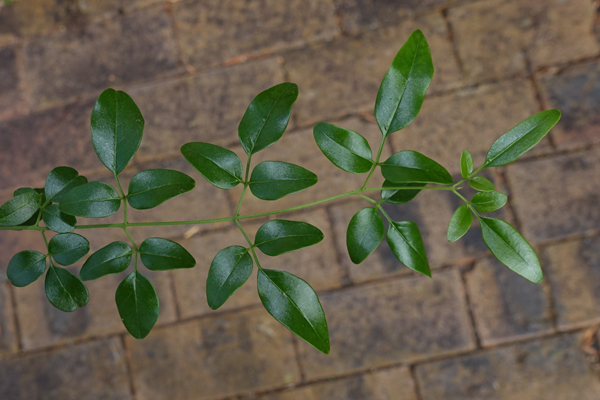
Here is another plant with compound leaves. In this case, its leaves are opposite.


Triple Leaf Jasmine, Jasminum didymum subsp. racemosum - for more details on this plant see:
https://toowoombaplants2008.blogspot.com/search?q=didymum

 
Despite its deceptive common name, it is the leaflets that are triple, not the leaves. If you look closely (double click on the photo) you can see the beginnings of shoots in the leaf axils.

Plants with compound leaves, having three leaflets arranged in this pattern are called “trifoliate” (or some people prefer “trifoliolate”, which is such a tongue twister that the word is dropping out of use, despite its being more correct). So the jasmine above has opposite, trifoliate leaves.

Here is another example of compound leaves which are trifoliate.

Tingletongue, Dinosperma erythrococcum. 
 
Can you see that there is a tiny shoot at the base of those trifoliate leaves? And that the leaves are opposite?

Now for a plant family - one with spikes.
A word that helps you identify quite a few of the trees in our local scrubs and dry rainforests is Sapindaceae, (Usually pronounced SAP-IN-DAY-SEE)
It is the name of a plant family, and we have an unusually large number of its members here in our local area. They all have alternate leaves. A few, (like the Scrub Boonaree) have simple leaves, but most of our local Sapindaceae have pinnately compound leaves.
Members of this family can be picked out from other plants with pinnate leaves by a small spike at the tip of the rachis, just where the top leaflet-stem joins on.


Scrub Boonaree, Cupaniopsis parvifolia. FAMILY: Sapindaceae

 You will also find spikes on the rachis-tips of a plant we looked at, earlier in this blog.


White Beetroot Tree Elattostachys xylocarpa.  FAMILY: Sapindaceae

We’d better have a closer look


 White Beetroot Tree, Elattostachys xylocarpa. FAMILY: Sapindaceae

And here's another member of the Sapindaceae family.


Pitted Coogera, Arytera foveolata. FAMILY: Sapindaceae
 
The spikes at the tip of the rachis, of its pinnately compound, alternate leaves, are rather blunt.
 
 
Pitted Coogera, Arytera foveolata. FAMILY: Sapindaceae


Looking at the back of the Beetroot Tree's leaflets, you can notice another interesting feature.


White Beetroot Tree, Elattostachys xylocarpa.

There are little hairy pits, at each junction of a side vein with the main central vein,. These pits are called domatia. The word means “little homes”, and that’s exactly what domatia are.


White Beetroot Tree, Elattostachys xylocarpa.
 
Domatia are good investments for the trees that have them. They have evolved these structures so they can be landlords. Small mites move in, and “pay their rent” by preying on small insects which would otherwise eat the leaves.

Some species of plants have them, and some don't. Where domatia are present, they give another clue to the identity of the plant.

These leaves also have domatia.
Pitted Coogera, Arytera foveolata

You could easily overlook them, couldn't you? If you double-click on the photo they will be easier to see, and now that you know the word, domatium, perhaps you will look with more interest at the backs of leaves and leaflets.

And I hope that you will be more aware of whether leaves are alternate or opposite, and whether they are simple or compound. If they are compound, you can look to see whether they are trifoliate or pinnate. If they are pinnate you can check  whether they are members of the Sapindaceae family.

What else can you learn about leaves?


Thursday, July 17, 2008

Deep Yellowwood

Rhodosphaera rhodanthema
Family: ANACARDIACEAE
This plant is another mango relative.
In his comment on my “Toowoomba Trees” article, Mick included it as a suggested Camphor laurel replacement.
I couldn’t believe how fast mine grew when I first planted it. It’s now eight years old, but reached almost the size shown in the picture in only four of them, when it decided to put on the brakes. Its reputation as a slow grower, eventually reaching camphor laurel size, is clearly not based on its early years.

This fast growth does make it satisfying to grow, as a pretty, shady tree is obtained in a very short time.
Last September my tree responded to the drought with this lovely crop of flowers, and was a buzzing mass of native bees.
Despite this it produced no fruit at all. This photo is of a friend’s tree. The berries look as though someone’s been polishing them with Nugget, don’t they?

Deep yellowwoods are drought and frost hardy trees, and are rather hard to set alight. We sometimes find ourselves being told not to plant natives in bushfire-risk areas because “they are so flammable”. This is very good advice where Eucalypts are concerned - and applies rather more strongly to some very non-native trees, like pines and cypresses - but drought-hardy rainforest trees like this one are a good choice where bushfires might be a problem.

Saturday, February 14, 2009

Deep Yellowwood now in Fruit

Rhodosphaera rhodanthema
Family: ANACARDIACEAE
Our local deep yellowwoods are fruiting particularly well, this year. What beautiful trees they are, with their bunches of long-lasting nut-brown fruits against the canopy of dark green leaves.
If you want to try growing these seeds for yourself, you’ll need to “scarify” them. Otherwise they are slow to germinate because they have to wait for their own hard seed-coating to decay before they can get through it.
"Cut off the end with side-cutters", I was advised. I found it was more a case of gnawing away carefully with said implement, (on the end opposite the stalk) until I could glimpse the waxy grey kernel inside.
These are fast-growing trees, producing a respectable little shade tree in four years.


See my article from June 2008 for more details, and photos of the showy flowers.

Saturday, December 31, 2016

Dry Rainforest Trees

Suitable for Gardens


Auranticarpa rhombifolia

Not all “rainforest" trees are the same. As a general rule, the wetter the rainforest type, the more likely its plants are to have evolved  shallow root systems. Trees of typical rainforests are likely to be problematical if planted close to buildings, driveways, paths, and drains. Many of them are also too large to be suitable for suburban gardens.
“Dry Rainforest” plants are their drought-hardy relatives. Unlike the plants of wetter rainforests, they can’t count on getting regular rainfall. The secret of their survival in their drought-prone native habitats is their tendency to put down deep roots as fast as they can, to find water deep underground.
They tend to be smaller trees than their big rainforest relatives.
They also prune well.
These three habits make them very garden-friendly.
1. Their deep-rooting habit means that they don’t make much use of the upper layers of soil. They can be planted close together, and are happy to share the space in the upper layers of the soil where most small garden plants want their roots to be. They are also less likely to damage paths, driveways, house foundations, and to send their little roots into our pipes and sewers. (Yes, of course they will do damage if you tempt them by planting them right next to a leaky pipe, or place a large plant smack up against a brick wall. Use some commonsense here! Think low-risk, not no-risk. No-risk means a garden of concrete and plastic plants.)
2. Their smaller size means that we can grow nice shady trees which won’t outgrow our suburban-sized gardens.

Denhamia bilocularis

3. Their adaptability to shaping and pruning means that they make good hedges or dense shrubs if pruned to the size of your choice. Cutting them back hard encourages the formation of multiple trunks. They can also left (or encouraged) to grow as shady little single-trunked trees. Trim the lower branches a bit, and you have a spot for a bird bath or a garden seat.
Too many trees? No problem! Cut some off at the ankles and let them regrow as multi-trunked shrubs.


Notelaea microcarpa

4. And their drought hardiness means that once established they will live a normal lifespan, possibly hundreds of years, without ever needing more rainfall than our erratic climate gives them. Like most plants, they appreciate extra water, especially in winter or dry times when their natural habit is to drop some of their leaves to conserve water. Watering keeps them dense and shady - but those who can’t manage the water can just wait it out. When the rains start, their canopies will thicken up again.

Some of our Local Dry Rainforest Trees:

Acmena smithii (Syzygium smithii) LILLYPILLY, COMMON  
Acronychia laevis ACRYONYCHIA, GLOSSY  
Alangium villosum MUSKHEART, BLACK  
Alectryon diversifolius BOONAREE, SCRUB   
Alectryon pubescens BOONAREE, HAIRY  
Alectryon subcinereus BIRDS EYE, QUINCE LEAFED  
Alectryon subdentatus BIRDS EYE, HOLLY LEAFED   
Alectryon tomentosus BIRDS EYE, HAIRY  
Alectryon connatus BIRDS' EYE, COMMON  
Alectryon oleifolium ROSEWOOD, WESTERN  
Alphitonia excelsa ASH, SOAP   
Alstonia constricta BITTERBARK   

Aphananthe philippinensis  ELM, NATIVE  
Araucaria cunninghamii PINE, HOOP  
Arytera distylis COOGERA, TWIN LEAFED  
Arytera foveloata COOGERA, PITTED  
Atalaya salicifolia WHITEWOOD, BRUSH   


Atalaya salicifolia


Auranticarpa rhombifolia HOLLYWOOD, GOLDEN   
Backhousia angustfolia MYRTLE, CURRY   
Baloghia inophylla BLOODWOOD, BRUSH  
Brachychiton acerifolius FLAME TREE  
Brachychiton discolor  LACEBARK  
Brachychiton populneus KURRAJONG  
Brachychiton rupestris BOTTLE TREE  
Bridelia exaltata IRONBARK, BRUSH  
Bridelia leichhardtii IRONBARK, LEICHHARDTS  
Bursaria incana BURSARIA, FROSTY  
Capparis arborea CAPER TREE, RAINFOREST  
Capparis mitchellii CAPER TREE, MITCHELL'S  
Casearia multinervosa CASEARIA 
Castanospermum australe BEAN, BLACK   
Citronella moorei CHURNWOOD  
Citrus australis LIME, NATIVE ROUND   
Claoxylon australe BRITTLEWOOD    
Croton insularis CROTON, SILVER   
Cryptocarya bidwillii LAUREL, YELLOW
Cryptocarya glaucescens  JACKWOOD  
Cryptocarya triplinervis var. pubens LAUREL, HAIRY BROWN  
Cupaniopsis parvifolia TUCKEROO, SMALL LEAF   
Denhamia bilocularis (Maytenus bilocularis) ORANGEBARK, HEDGE   
Denhamia celastroides DENHAMIA, COMMON  
Denhamia disperma (was Maytenus disperma) BOXWOOD, ORANGE  
Denhamia pittosporoides DENHAMIA, VEINY   
Dinosperma erythrococcum TINGLETONGUE  
Diospyros australis EBONY, PLUM  

Diospyros humilis EBONY, SMALL LEAFED   

Diospyros humilis

Diploglottis australis (Diploglottis cunninghamii) TAMARIND, NATIVE   
Drypetes deplanchei TULIPWOOD, YELLOW 
Dysoxylum fraserianum ROSEWOOD  
Ehretia membranifolia KODA, THIN LEAFED  
Ehretia acuminata KODA  
Elaeocarpus obovatus QUANDONG, HARD    
Elaeodendron australe var. integrifolium 

              OLIVE PLUM, RED FRUITED  narrow-leafed
Elattostachys xylocarpa BEETROOT TREE, WHITE   
Emmenosperma alphitoniodes ASH, YELLOW   
Erythrina numerosa CORAL TREE, PINE MOUNTAIN   
Euroschinus falcatus RIBBONWOOD  
Everistia vaccinifolia EVERISTIA  
Excoecaria dallachyana POISON TREE, SCRUB  
Ficus rubiginosa FIG, SCRUB  
Flindersia collina ASH, LEOPARD   


Flindersia collina

Geijera parviflora WILGA  
Geijera salicifolia WILGA, SCRUB  
Guioa semiglauca GUIOA (Pronounced GHEE-OA)   
Linospadix monostachya WALKING STICK PALM  
Mallotus philippensis KAMALA, RED  
Melicope micrococca DOUGHWOOD, WHITE   
Myrsine variabilis (was Rapanea variabilis) MUTTONWOOD 
Neolitsea dealbata BOLLYGUM, GREY  
Notelaea microcarpa MOCK OLIVE, GORGE   
Owenia acidula APPLE, EMU  
Owenia venosa APPLE, ROSE   
Petalostigma pubescens QUIININE TREE, HAIRY  
Pittosporum angustifolium GUMBY GUMBY  
Pittosporum undulatum PITTOSPORUM, SWEET   
Planchonella cotinifolia (Pouteria cotinifolia) 

                                       CONDOO, SMALL LEAFED   
Psydrax buxifolium CANTHIUM, BOX-LEAFED  
Psydrax odoratum SWEET SUZIE 
Rhodosphaera rhodanthema YELLOWWOOD, DEEP   

 Rhodosphaera rhodanthema

Siphonodon australe IVORYWOOD  
Streblus pendulinus (Streblus brunonianus) WHALEBONE TREE 
Vitex lignum- vitae SATINWOOD
  

Some of our Local Dry Rainforest shrubs 

and Small Understorey Trees.

Alchornea ilicifolia DOVEWOOD, HOLLY
Alyxia ruscifolia CHAIN FRUIT 
Bursaria spinosa BURSARIA, SWEET  (Prickly. Good bird plant)
Carissa ovata KUNKERBERRY (Prickly. Good bird plant)  
Clerodendron floribundum LOLLY BUSH  
Clerodendron tomentosum LOLLY BUSH, HAIRY  
Denhamia silvestris (Maytenus silvestris) ORANGEBARK, NARROW LEAFED      

Dodonaea sinuolata HOPBUSH, THREADY-LEAFED  
Dodonaea stenophylla HOPBUSH, STRINGY LEAFED   
Dodonaea tenuifolia HOPBUSH, FERN-LEAFED  
Dodonaea triangularis HOPBUSH, TRIANGLE LEAFED  
Dodonaea triquetra HOPBUSH, FOREST   
Dodonaea viscosa subsp angustifolia HOPBUSH, NARROW LEAFED  
Homalanthus populifolius BLEEDING HEART  
Myoporum montanum BOOBIALLA, MOUNTAIN  
Notelaea linearis MOCK OLIVE, NARROW LEAFED  
Pittosporum revolutum PITTOSPORUM, YELLOW  
Pittosporum viscidum BIRDS NEST BUSH (Prickly. Good bird plant) 
Psychotria daphnoides PSYCHOTRIA, HEDGE  
Psychotria loniceroides PSYCHOTRIA, HAIRY            
Santalum lanceolatum SANDALWOOD, NORTHERN 
Santalum obtusifolium SANDALWOOD, SHRUB
Trema tomentosa PEACH, POISON 
Turraea pubescens WITCH HAZEL, NATIVE  

Tuesday, June 13, 2017

Frost Resistant Plants

Here are some potential good ones for Toowoomba and the Eastern Darling Downs.
(But note that there are no guarantees. For some reasons for this, see articles below the list.)
 
Best Species for  Heavy Frosts (over approx -7°C )
e.g. OPEN PLAINS OF THE DARLING DOWNS, VERY EXPOSED AREAS, HOLLOWS BELOW HILLS

Large Trees
Araucaria bidwillii  BUNYA PINE
Casuarina cristata BELAH
Casuarina cunninghamiana RIVER SHE-OAK
Eucalyptus camaldulensis RIVER RED GUM
Eucalyptus eugenioides THIN LEAFED STRINGYBARK
Eucalyptus viminalis MANNA GUM

Medium Trees
Acacia deanei DEANE’S WATTLE
Acacia harpophylla BRIGALOW
Acacia implexa LIGHTWOOD (If seed of local provenance)
Acacia maidenii MAIDEN’S WATTLE
Acacia pendula WEEPING MYALL
Acacia stenophylla DALBY WATTLE
Callitris glaucophylla WHITE CYPRESS
Cupaniopsis parvifolia    SCRUB TUCKEROO (protect while small)
Eucalyptus conica FUZZY BOX
Geijera salicifolia    SCRUB WILGA
(protect while small)
 Melaleuca bracteata BLACK SHE-OAK
Melia azedarach WHITE CEDAR
Melicope micrococca. WHITE DOUGHWOOD
Pittosporum angustifolium GUMBY GUMBY

Small Trees
Acacia deanei DEANE’S WATTLE
Acacia hakeoides HAKEA WATTLE
Hymenosporum flavum    NATIVE FRANGIPANI

Shrubs
Bursaria spinosa SWEET BURSARIA
Denhamia bilocularis    HEDGE ORANGEBARK
Denhamia silvestris NARROW-LEAFED ORANGEBARK
Dodonaea triangularis TRIANGLE LEAF HOPBUSH
Eremophila maculata SPOTTED EMU BUSH
Hibbertia aspera ROUGH GUINEA FLOWER
Lomatia silaifolia    CRINKLE BUSH
Senna artemisioides subsp. zygophylla DESERT SENNA
Tasmannia insipida NATIVE PEPPER BUSH
Xanthorrhoea glauca GRASS TREE

Ground Cover
Eremophila debilis    DEVIL’S MARBLES
Lilies
Dianella caerulea BLUE FLAX LILY
Dianella longifola LONG LEAFED FLAX LILY
Dianella revoluta BLACK ANTHER FLAX LILY

Rushes and Sedges
Lomandra longifolia LONG LEAFED MATRUSH
Carex appressa TALL SEDGE
Juncus usitatus PIN RUSH

Grasses
Poa labillardierei TUSSOCK GRASS
Poa sieberiana SNOW GRASS
Themeda triandra KANGAROO GRASS

 Also all the grasses which grow naturally on our black soil plains.
Climbers
Hardenbergia violacea PURPLE WANDERER

For Areas of Moderate Frosts (approx. -3°C to -5°C)
e.g. WESTERN EDGES OF TOOWOOMBA, HILLS AND LIGHTLY TREED AREAS OF DARLING DOWNS
The above species, plus:
Large Trees
Araucaria cunninghamii HOOP PINE
Castanospermum australe BLACK BEAN
Corymbia intermedia PINK BLOODWOOD
Diploglottis australis NATIVE TAMARIND
Dysoxylum fraserianum ROSEWOOD
Eucalyptus biturbinata LARGE FRUITED GREY GUM
Eucalyptus crebra NARROW LEAFED IRONBARK
Eucalyptus microcorys TALLOWWOOD
Eucalyptus moluccana GUM TOPPED BOX
Eucalyptus pilularis BLACKBUTT
Eucalyptus tereticornis FOREST RED GUM
Euroschinus falcata RIBBONWOOD
Ficus rubiginosa SCRUB FIG

Medium Trees
Acacia irrorata GREEN WATTLE
Acacia melanoxylon BLACKWOOD
Acmena smithii COMMON LILLYPILLY
Allocasuarina luehmannii BULL OAK
Allocasuarina torulosa HILL SHE-OAK
Alphitonia excelsa SOAP TREE
Angophora floribunda ROUGH BARKED APPLEGUM
Aphananthe philippinensis NATIVE ELM
Auranticarpa rhombifolia GOLDEN HOLLYWOOD
Brachychiton acerifolius FLAME TREE
Brachychiton discolor LACEBARK
Brachychiton populneus KURRAJONG
Brachychiton rupestris BOTTLE TREE
Capparis mitchellii NATIVE CAPER
Cryptocarya glaucescens JACKWOOD
Cryptocarya triplinervis var. pubens HAIRY BROWN LAUREL
Elaeocarpus obovatus HARD QUANDONG
Eucalyptus melanophloia SILVER LEAVED IRONBARK
Eucalyptus melliodora YELLOW BOX
Eucalyptus populnea BIMBIL BOX
Flindersia collina LEOPARD ASH
Grevillea robusta SILKY OAK
Guioa semiglauca GUIOA
Mallotus philippensis RED KAMALA
Pittosporum undulatum SWEET  PITTOSPORUM

Small Trees
Acacia fimbriata  BRISBANE WATTLE
Acacia hakeoides HAKEA WATTLE
Acacia salicina WILLOW WATTLE
Acronychia oblongifolia WHITE ASPEN
Banksia integrifolia TREE BANKSIA
Croton insularis SILVER CROTON
Diospyros humilis SMALL LEAFED QUEENSLAND EBONY
Leptospermum polygalifolium TANTOON TEA TREE
Melaleuca quercina OAKEY BOTTLEBRUSH
Melaleuca viminalis (Callistemon viminalis) RED WEEPING BOTTLEBRUSH
Pittosporum viscidum BIRDS NEST BUSH
Psydrax buxifolia (Canthium buxifolium) BOX LEAFED CANTHIUM

Shrubs
Acacia decora PRETTY WATTLE
Acacia podalyriifolia QUEENSLAND SILVER WATTLE
Dodonaea triangularis TRIANGLE LEAF HOPBUSH
Dodonaea triquetra LARGE LEAF HOP BUSH
Hovea lanceolata LANCE LEAFED HOVEA
Hovea longipes BRUSH HOVEA
Indigofera australis NATIVE INDIGO
Jacksonia scoparia DOGWOOD
Carissa ovata KUNKERBERRY
Cassinia laevis COUGH BUSH
Dodonaea viscosa STICKY HOP BUSH
Maireana microphylla SMALL LEAFED BLUEBUSH
Pittosporum revolutum HAIRY PITTOSPORUM
Rhagodia parabolica FRAGRANT SALTBUSH
Rhagodia spinescens HEDGE SALTBUSH
Solanum aviculare KANGAROO APPLE

Lilies
Alocasia brisbanensis CUNJEVOI
Doryanthes palmeri SPEAR LILY

Other flowering plants
Swainsona galegifolia DARLING PEA
Climbers
Hardenbergia violacea HARDENBERGIA
Clematis glycinoides OLD MAN’S BEARD
Kennedia rubicunda RED KENNEDY PEA
Pandorea jasminoides WONGA VINE
Billardiera scandens APPLE DUMPLINGS
Hardenbergia violacea HARDENBERGIA
Hibbertia scandens SNAKE VINE
Pandorea pandorana WONGA VINE

Ground Covers
Atriplex semibaccata CREEPING SALTBUSH
Enchylaena tomentosa RUBY SALTBUSH
Small Flowering Plants
Chrysocephalum apiculatum YELLOW BUTTONS
Goodenia rotundifolia STAR GOODENIA
Scaevola albida FAIRY FAN FLOWER

Lilies
Bulbine bulbosa BULBINE LILY
Grasses
Microlaena stipoides WEEPING RICE GRASS
Rushes and Sedges
Schoenoplectus validus RIVER CLUBRUSH
Lomandra hystrix CREEK MATRUSH


Tolerates Light Frosts Only (to approx -2.5°C)
(e.g. MOST FROSTS AROUND TOOWOOMBA AND ALONG THE RANGE)
Large Trees
Argyrodendron actinophyllum BLACK BOOYONG
Eucalyptus saligna SYDNEY BLUE GUM
Ficus macrophylla MORETON BAY FIG
Ficus watkinsiana GREEN LEAFED MORETON BAY FIG
Flindersia australis CROWS ASH
Lophostemon confertus BRUSH BOX
Toona ciliata RED CEDAR

Medium Trees
Arytera divaricata COOGERA
Atalaya salicifolia SCRUB WHITEWOOD
Bursaria incana FROSTY BURSARIA
Capparis arborea RAINFOREST CAPER TREE
Citrus australis NATIVE ROUND LIME
Cupaniopsis parvifolia SCRUB TUCKEROO
Denhamia disperma ORANGE BOXWOOD
Denhamia pittosporoides VEINY DENHAMIA
Diospyros australis PLUM EBONY
Drypetes deplanchei YELLOW TULIPWOOD
Elattostachys xylocarpa WHITE BEETROOT TREE
Emmenosperma alphitoniodes YELLOW ASH
Ficus coronata CREEK SANDPAPER FIG
Flindersia xanthoxyla LONG JACK
Guioa semiglauca GUIOA
Glochidion ferdinandi CHEESE TREE
Gmelina leichhardtii WHITE BEECH
Myrsine variabilis MUTTONWOOD
Polyscias elegans CELERYWOOD   
Rhodosphaera rhodanthema DEEP YELLOWWOOD
Streblus brunonianus WHALEBONE TREE
Vitex lignum-vitae SATINWOOD

Small Trees
Alectryon tomentosus HAIRY BIRDS EYE
Backhousia angustfolia MYRTLE, CURRY
Gossia bidwillii PYTHON TREE
Psydrax species  CANTHIUM
Streblus pendulinus WHALEBONE TREE

Shrubs
Alchornea ilicifolia, HOLLY DOVEWOOD
Pittosporum revolutum HAIRY PITTOSPORUM
Trema tomentosa TREMA